Graduate Humanities Symposium
Overview

Graduate Humanities Symposium
Friday, November 13, 2026 | 8:30 AM - 3:30 PM
USF Marshall Student Center - 3rd floor - MSC 3705
4103 Cedar Circle, Tampa, FL 33620
The third annual Graduate Humanities Symposium hosted by the USF Humanities Institute will be held Friday, November 13, 2026 in the Marshall Student Center. Come support our USF graduate student scholars and learn about their research. This event is free to attend and open to all students, faculty, staff, and the community.
Student presenters and faculty moderators are provided free breakfast, lunch, and a swag bag. Faculty interested in volunteering to serve as a panel moderator, please contact Jade Gennaro.
Detailed Schedule
8:30 am – 9:00 am | Check-in, Breakfast, and Opening Welcome (3705)
Free breakfast provided for presenters and moderators
9:00 am – 10:00 am | Panel Session I
-
The 19th Century American Identities (3704)
- Laura Almeida Delgado (English) Sojourner Truth’s Presence in the Northampton Association of Education and Industry
- Abby Grim (English) Women? Analyzing Queer Narrative Structuring in My Antonia
- Meg Hanna (English) Making Space for the American Self: Transcendentalism and Subject Formation
in Thoreau and Fuller
-
Changing Tides: Water, Food, and Land Security (3708)
-
George Smith (Anthropology) Catch-22: Navigating the Paradox Between Conservatism and Conservation Among Recreational Fishers in Tampa Bay.
-
Emily Walsh (Public Health and Anthropology) From Park Promise to Unregulated Landfill: The Burden of Not Knowing
-
Elizabeth Zacharias (Women’s, Gender, and Sexuality Studies) Inside the Food Pantry: From Autoethnography to Institutional Ethnography
-
10:15 am – 11:15 am | Panel Session II
-
Representation, Identity, and Power (3704)
-
Grace Glover (Mass Communications) Speaking in Code: Dogwhistles and Enthymematic Reasoning in Presidential Nomination Acceptance Speeches between 2000–2024
-
Najah Raniyah (Mass Communications) We’ve Got Your Back, Fellow SEAblings: Framing Civil Courage, Policy Pressure, and Southeast Asian Solidarity in Indonesia’s 2025 Protests
-
Ben Sperduto (English) Dreams, Dreamers, and the Reproduction of Whiteness in Speculative Fiction
-
-
Enduring Legacies from Ancient Greece (3708)
- Moderator: Matthew King (Associate Professor | History)
-
Emelia Brzakala (History) Embodying Miracles: Reanalyzing the Miracle Tablets and Disability in Fourth Century BCE Greece
-
Emily Najarian (English) The Evolution of Love: Investigating Personal Growth in Buffy the Vampire Slayer and Plato’s The Symposium
-
Melanie Wondracek (History) Fishing Beyond Subsistence: A New Reconstruction of the Local Fish Trade in Classical Athens
11:30 am – 12:30 pm | Panel Session III
-
Heavy is the Head: Ethics, Power, and Practice (3704)
- Moderator: Jesse Obert (Assistant Professor | History)
-
Tehami Ammad (Philosophy) Ethics is as Real as We Make It: An Inquiry into Metaphysical/Existential Sources of The Good via Hypocrisy
-
Matt Budisin (Philosophy) Socrates and the Question of Political Power
-
Allison Smith (Mass Communications) Behind the Words: The Necessity of Humanizing Leadership Language Formation, An Example of Truly Human Leadership and Stewardship Shaping Communication and Culture at Barry-Wehmiller
-
Beyond the Page: Practical and Pedagogical Examples of Multimedia Literacies (3708)
- Moderator: Heather O’Leary (Associate Professor | Anthropology)
-
Amber Barrett (Anthropology) Climate Change and Representation in the Comic Book Industry
-
Virginia Boyd (English) Conceptualizing University Writing Centers as (Multi)Literacy Centers
12:30 pm – 1:15 pm | Lunch (3705)
Free lunch provided for presenters and moderators
1:15 pm – 2:15 pm | Professionalization Workshop (3705)
Want practice for the job market? Learn how to perfect and customize your answers to common academic interview questions in this Mock Job Interview Workshop. Graduate students at any level are invited to sit in the "hotseat" or to supportively listen in the audience.
2:30 pm – 3:30 pm | Panel Session IV
-
Reckoning with Colonialism (3704)
-
Moderator: Elizabeth Ricketts-Jones (Associate Professor of Instruction | English)
-
Brett Keeley (Latin American and Caribbean Studies) Ua mau ke ea o ka ‘āina i ka pono: An Examination of Modern American Colonialism in Hawai’i
-
Maeve Kiley (English) The Morrígan Rewritten: How Colonial Politics and the Celtic Revival Reshaped Women in Irish Myth
-
Hailey Patellis (English) "He Practiced Vanishing": An Examination of “Grievability” and Intentional Forgetting in Chris Eyre’s Smoke Signals
-
-
On the Outside Looking In: Belonging During Critical Moments (3708)
- Moderator: Michelle Hughes Miller (Professor | WGSS)
-
Mykenzie King (Behavioral and Community Science and Women’s, Gender, and Sexuality Studies) Infertility Stigma and Intersection Gender Theory
-
Carmen Lok (English) Yellow the Color of Flesh: An Exploration of Cultural Worthiness
-
Carlin Steere (English) "Mourning Doves"
-
Micayla Valentine (English) Cataloguing the Wife: Gendered Grief in Max Porter’s Grief Is the Thing with Feathers
Symposium Format
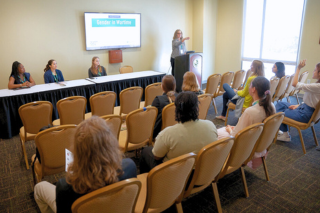
Panel Discussions are the traditional presentation method for most disciplines. A panel has a general topic (for example, “Gender Roles in the 19th Century") with 3 scholars, each of whom will present their individual work that falls under the general topic. Each individual presentation should be 12 – 15 minutes long. After all individual presentations, the group will take questions from the audience.
Mock Job Interview "Hotseat"
- How can I describe the depth of my Ph.D. research in 1-2 minutes?
- How do I pivot from a scary interview question?
- What does a strong interview look like?
- How can I begin preparing now, even if I am not yet on the market?
Graduate students at any level are invited to sit in the "hotseat" at this Mock Job Interview mini-workshop to personalize your responses to common academic interview questions. Learn from interdisciplinary faculty the tricks and traps of real-life answers. Sign-up to be interviewed or supportively listen in the audience.
Students presenting in the symposium will have an opportunity to sign-up during symposium registration. Students attending the symposium can sign-up by emailing Jade Gennaro.
-
Timeline
Applications Open
September 1
Apply to present your humanities-related research at the November 2026 Graduate Humanities Symposium.
Applications Due
October 9
All applications are due on Friday, October 9.
Decision Emails Sent
October 16
Applicants will receive a decision email on the status of their application to the symposium.
Registration Deadline
October 30
Accepted student presenters submit their symposium registration to confirm their spot in the program.
Graduate Humanities Symposium
November 13
Symposium schedule and program will be released by November 6. Students are encouraged to stay for as much of the symposium as their schedule allows. The symposium is free to attend and open to the public. Faculty, staff, students, community members, family, and friends are welcome to attend. Breakfast and lunch is provided for student presenters, moderators, and volunteers.
Frequently asked questions
What information do I need for my application?
When you're ready to apply, here's what we'll ask for in the application:
- Name and pronouns
- USF email
- Masters or PhD student
- Major / Program
- Title of project
- Abstract (PDF file upload)
- (200 words max.) This is where you submit a brief summary of your project or research. Even if your project is not complete yet, you can still submit a general overview for application purposes. Writing the abstract in future tense may help. Please include your name and project title in the abstract.
Does my project need to be complete at the time of application?
No. An abstract is sufficient for the application. Students are encouraged to apply with an existing project or research that may still be in progress.
What is the symposium registration?
After decision emails are sent, accepted students will be sent a link to register for the symposium. This will confirm the student's spot in the program. The registration form will also ask students to submit their scholar biography and note any dietary restrictions or accommodation requests.
What goes into my biography?
The biography is a few sentences that describes your academics interests, course of study, and future plans. Please write your biography in 3rd person and limit it to 3-5 sentences (less than 100 words).
Example: "Jane completed her bachelor's degree in English at the University of Central Florida and is now pursuing her PhD in English literature at USF. Her research focuses on copyright history and it's impacts on 19th century publishers. After graduation, Jane hopes to get a position as a tenured faculty member and start her own book club. Jane volunteers at her local community garden and grows her own peppers."
How long should my presentation be?
You should plan to speak for 12 – 15 minutes. If you go over 15 minutes, the moderator will kindly let you know your time is up.
Does anyone else read my research paper?
No. You are the only person who sees your paper. You can read directly from it, or bring notes to guide your oral presentation.
Do I need to have visual aids?
Visual aids like PowerPoints or images are completely optional. We will have the A/V capabilities if you want to make use of them.
Will there be food at the symposium?
Yes, presenters and moderators are provided free breakfast and lunch.
What if I have a class scheduled during my presentation time?
If your presentation time conflicts with a class, you should inform your instructor right away to see if they can support you in this opportunity to present at the symposium. For further assistance or if you cannot present at your original scheduled time, please contact Jade von Werder.
I'm from the St. Petersburg campus. Can I participate?
Yes! Graduate students from all campuses are invited to apply. If transportation is an obstacle to participating in the conference in-person on the Tampa campus, please contact Jade Gennaro.
Are the presentations juried or judged?
No. This is a low-stakes symposium to practice presenting your research and prepare for future conferences.
I've never participated in a symposium before and I'm not sure if I should apply. How do I know if I'm ready?
You’re ready! The Humanities Institute staff is here to help you plan and prepare if you need help. The symposium is designed to be professional, but supportive and fun.